Author: Admin

  • Germany’s PMI “Recovery” Is Built On Layoffs, Price Inflation, And State Expansion

    Germany’s PMI “Recovery” Is Built On Layoffs, Price Inflation, And State Expansion

    Submitted by Thomas Kolbe

    Economic indicators suggest a stabilization in Germany’s services sector. Yet the apparent improvement in the corresponding index follows massive staff reductions and efficiency measures undertaken by companies responding to a political structural crisis.

    In Berlin, the great tremor has begun. For almost exactly seven months now, the German economy has been pregnant with the federal government’s oversized debt package—and from an economic standpoint, it has delivered nothing so far. No growth in sight. Disappointment is spreading through the government quarter.

    Any attempt to explain to politicians that artificial state demand creates no real value but merely beautifies GDP statistics would likely be pearls before swine. And yet Chancellor Friedrich Merz and his cabinet are hoping for positive economic headlines to somehow stumble across the finish line of the 2026 super-election year.

    A Flicker of Hope

    As if an early success story had been ordered at the push of a button, the HCOB Services PMI (Purchasing Managers’ Index) reported an increase in January from 52.7 to 53.3 points—a three-month high.

    A figure that fuels false hopes in Berlin. Because what lies beneath the data is almost precisely the opposite of what would now be urgently required: Germany’s services sector is cleaning up its balance sheets, shedding staff on a massive scale in order to realize short-term efficiency gains. What we are witnessing is the forced reaction of the economy to ever-rising energy costs and higher input prices, which—made visible through the inflation index—are passed on to customers and artificially inflate the headline figures. Adjusted for prices, the downturn continues.

    Meanwhile, the countless new regulations raining down on the economy from Brussels and Berlin ensure that this diagnosis will not change. A whole bundle of new emissions rules, border adjustment mechanisms, data-usage standards, and countless other ideas from the EU’s industrious bureaucratic think tanks are making life even harder for companies—presumably the much-praised “debureaucratization” that Friedrich Merz keeps fantasizing about.

    Let us consider another data point that highlights the depth of Germany’s economic crisis. Current figures from the hospitality sector show that more than 97,000 applicants are now competing for just 19,000 open positions.

    Last year, the sector lost roughly four percent of its real business volume, and layoffs are now following the sharp downturn. The hospitality industry crystallizes the collapse of German purchasing power, as households—after years of inflation and a deteriorating labor market—are forced to tighten their belts.

    It cannot be emphasized often enough: the long-cultivated narrative of a German “skilled labor shortage,” promoted by politics and the media for years, was from the outset a political vehicle to flank open-border policies. Genuine skill shortages are addressed by companies through the international labor market—by the private sector, not through state-driven mass immigration into Germany’s welfare system. The political left has made the expansion of its voter base a strategic objective, and no reversal in migration policy is in sight.

    Here, at the economic front line of the domestic economy, political deception is laid bare. Unemployment will become an economic reality in the coming years, and it will place a heavy burden on social life in Germany.

    The State Creates a Buffer

    Meanwhile, the inevitable is unfolding in the economy: companies are cutting staff and raising prices wherever possible, making overall economic indicators appear more positive than they truly are—without any real new demand emerging. At the same time, selected firms benefit from state-subsidized projects in areas such as climate policy or military production, further reinforcing the illusion of expansion.

    The index figures obscure another crucial aspect of the labor-market debate. Last year, official unemployment in Germany rose by just over 100,000 people. This figure masks the reality that many workers were shifted into short-time work, the number of pensioners increased, and—contrary to the government’s political folklore—the state continued to systematically expand the public sector.

    Over the past five years, the number of public employees has grown annually between 1.8 and 2.6 percent. Over the past decade, nearly one million new state employees have been added. Today, five and a half million people work in Germany’s public sector—a bloated machine of capital destruction.

    Projecting this continuous expansion forward into 2025, the number of public employees will likely have increased by another 100,000. This is all the more plausible given that distributing the massive new debt package of more than €50 billion per year from the special fund requires a vast regional bureaucracy that far exceeds existing personnel capacities.

    Through the costly expansion of its administrative apparatus, the state is masking rising unemployment—a consequence of regulatory policy and the energy crisis that can no longer be concealed—and has driven the German economy into progressive deindustrialization.

    The Source of Prosperity

    Germany’s economic policy debate lacks substance. It must be emphasized far more clearly that prosperity is exclusively the product of private investment and cannot be conjured up on the drafting tables of central planners in Berlin and Brussels. Only private investment, guided by free markets and consumer demand, expands an economy’s productive capacity.

    The “special fund,” the largest state debt program in the history of the Federal Republic, is causing massive crowding-out effects in capital markets. Scarce resources are locked into subsidy schemes, free capital retreats, labor is tied up in unproductive sectors—and the state, in its desperation, fuels the general decline.

    These trends are well documented. Figures from the ifo Institute in November show that the investment expectations index fell to −9.2 points. This means a growing number of companies plan to sharply reduce investment this year—especially in industry, where the long-observed trend of capital withdrawal continues. The situation is particularly dramatic in automotive manufacturing, where the index plunged to −36.7 points.

    The chemical industry is also fighting for survival. With capacity utilization of only 70 percent, most energy-intensive firms are operating deep in the red. We are facing an economic depression that has manifested itself since 2018 in Germany’s declining industrial output. Overall corporate investment last year was around seven percent below the previous year’s level. Since 2018, German industry has lost more than 15 percent of its production volume.

    The country is growing poorer—while poverty migration into the welfare system continues unabated. On a per-capita basis, the effect is even clearer. Germany’s enormous redistribution machine is attempting to conceal the emerging social conflict by intensifying its raid on the middle class through ever more aggressive taxation.

    Germany reached its tipping point in 2018. Since then, the economy has stagnated, and overall productivity has declined—a clear indicator that the scaled-up interventionism of the state is crowding out investment capital while expanding a parasitic public sector.

    This is a dramatic finding with regard to technological progress, which should have led to massive productivity gains but cannot materialize in Germany amid the flight of companies and capital.

    Germany is heading toward growing distributional conflicts. Rising deficits in the social-security system are harbingers of an internal social storm that will unfold along ethnic and cultural lines.

    That the state is now rapidly deploying a censorship apparatus to suppress debate about the consequences of these policies should deeply concern everyone. The hastily formulated thesis that “the crisis is the solution” cannot solve individual financial problems, nor can it alleviate fears about personal safety in a country of concrete barriers and knife-free zones.

    The collapse of the welfare state shifts economic responsibility and social security back onto individuals. Recovery is possible. It begins when the state is no longer seen as the savior, but as the cause of the present crisis. Until then, the road ahead will be long and rocky.

    * * * 

    About the author: Thomas Kolbe, a German graduate economist, has worked for over 25 years as a journalist and media producer for clients from various industries and business associations. As a publicist, he focuses on economic processes and observes geopolitical events from the perspective of the capital markets. His publications follow a philosophy that focuses on the individual and their right to self-determination.

    Loading recommendations…
  • Decline Rewritten: The Changing Face Of American Shopping Malls

    Decline Rewritten: The Changing Face Of American Shopping Malls

    Authored by Panos Mourdoukoutas via The Epoch Times (emphasis ours),

    Shopping malls, long an economic and cultural fixture of American life, are facing sustained pressure but are not disappearing altogether.

    A sign at the Mall of America is pictured in Bloomington, Minn., on Feb. 2, 2006. Karen Bleier/AFP via Getty Images

    Instead, the sector is undergoing creative destruction, as traditional mall formats give way to new concepts that reflect shifting consumer behavior and market conditions, according to recent industry data.

    A research report by Capital One Shopping (COS) outlines the magnitude of the challenge facing the mall sector, citing rising mall closures that remain vacant for an average of nearly four years, as well as vacancy rates that are 112 percent higher than the overall retail vacancy rate.

    COS also estimates that as many as 87 percent of large shopping malls could close over the next decade.

    Adaptation Over Terminal Decline

    At the same time, COS data indicate a reversal of earlier trends. From 2021 through 2025, mall openings exceeded mall closures, suggesting adaptation rather than terminal decline. In 2025 alone, 9,410 new mall stores opened, nearly double the number that closed.

    Additional evidence of revival appears in a recent article published by Growth Factor. Author Clyde Christian Anderson reported that indoor mall foot traffic in March 2024 rose 9.7 percent year over year, open-air shopping center traffic increased 10.1 percent, and outlet mall traffic climbed 10.7 percent—each exceeding pre-COVID-19 pandemic levels.

    “The numbers don’t lie. After years of decline, shopping malls are experiencing their strongest performance since before the pandemic. This isn’t some temporary holiday bump or seasonal fluke. We’re looking at sustained growth that’s reshaping how we think about physical retail spaces,” Anderson wrote.

    Anderson also noted a structural shift in traffic patterns between 2019 and 2022, with increased weekday visits reflecting changes in work habits and consumer routines.

    “The data tells a compelling story of adaptation rather than decline. Malls are evolving into experiential destinations that blend shopping, dining, entertainment, and community spaces. The rise of work-from-home culture has shifted traffic patterns, with more visitors arriving during weekdays and earlier in the day,” he said.

    A Key Feature

    Retail expert Amrita Bhasin points to one feature that drives traffic to shopping malls and retail centers: private clubs.

    “Private clubs typically appeal to younger people seeking opportunities to socialize and dine in person,” she told The Epoch Times.

    By bringing them to a mall, these people have to pass by stores and may be more likely to shop as a result. Young people are especially interested in wellness, fitness, and health-related private clubs, as this is a growing trend.”

    According to research from the Federal Reserve Bank of Richmond, the origins of the American shopping mall date back to 1907, when Baltimore’s Roland Park Business Block introduced a small cluster of shops in a planned suburban setting.

    By the 1930s, malls expanded to include multiple stores under one roof and ample parking, becoming convenient destinations for suburban consumers.

    The model gained momentum in the 1950s and 1960s, as department stores and restaurant chains joined mall developments, turning them into central commercial and social hubs.

    Early examples include Southdale Center in Edina, Minnesota; Big Town Mall in Glen Burnie, Maryland; and Randhurst Center in Mount Prospect, Illinois.

    As malls multiplied, competition intensified, and profit margins narrowed, pushing weaker retailers out. The situation deteriorated further during the stagflation of the early 1980s and accelerated with the rise of eCommerce in the early 2000s, as online retailers increasingly displaced brick-and-mortar stores.

    The Great Recession of 2008–2009 and the COVID-19 pandemic marked a turning point, triggering widespread department store closures that reduced mall traffic and forced many properties to shut down. Some malls never reopened, while others were converted into warehouses or logistics hubs, leaving only about one-third still operating as retail centers.

    An Evolving Concept

    The mall concept continues to evolve, as outlined by the Tourism and Society Think Tank, which describes a broad transformation driven by eCommerce, changing consumer preferences, and declining department store appeal.

    “The traditional image of shopping malls in the United States, a symbol of the boom in mass consumption in the twentieth century, is undergoing a profound transformation that is redefining their role in both the economy and community life,” it said.

    This shift—driven by structural forces such as the rise of eCommerce, changing consumer habits, and the declining appeal of department stores—is giving rise to new models that seek to ensure the viability of these spaces in an increasingly competitive, technology-driven environment.”

    Redevelopment projects illustrate this shift. Burnsville Center in Minnesota is adding a skate park, an Asian-themed food hall, and a small zoo, while Lakeside Mall in Sterling Heights, Michigan, is being redeveloped into Lakeside Town Center, a mixed-use destination with residences, offices, parks, restaurants, and retail.

    “Malls aren’t back across the board, but the best located ones are showing evidence of a strong and durable rebound while weaker ones are being remade,” Ilir Salihi, founder and senior editor of IncomeInsider.com, told The Epoch Times.

    Salihi cited rising traffic and occupancy rates in 2025, with some top mall owners reporting occupancy near 96 percent and higher sales per square foot. He pointed to Boise Towne Square, which posted 12.2 percent year-over-year growth after adding a high-traffic anchor tenant, generating a halo effect that attracted new retailers.

    Top-tier malls in strong locations are reinventing themselves, while many mid-market indoor malls are being repurposed entirely,” Salihi said.

    “In places like Maryland, Lakeforest Mall has been approved for demolition and redevelopment into a mixed-use ‘mini city.’ Others are being replaced by grocery stores or apartment buildings. The result is a reshaped mall landscape rather than a uniform comeback.”

    Loading recommendations…
  • Why The Next Recession Will Be The Catalyst For Depression

    Why The Next Recession Will Be The Catalyst For Depression

    Authored by Charles Hugh Smith via OfTwoMinds blog,

    This is why a recession will catalyze a collapse of the credit-asset bubble-dependent economy down to its foundations.

    Narrative control works by having a pat answer for every skepticism and every doubt. Boiled down, the dominant narrative holds that the Federal Reserve (central banking) and the central government have the tools to quickly reverse any dip in GDP, a.k.a. recession, and return the economy to expansion.

    The unstated foundation of this narrative is that recessions are bad, as only permanent expansion is good. That this isn’t “free market capitalism” doesn’t bother anyone, because the whole point of central banking and government is to eliminate the rough edges of “free market capitalism” with the sandpaper of “state capitalism,” which creates or borrows as much money as needed to smooth over any spots of bother, a.k.a. recessions.

    That recessions are essential market dynamics is not part of the narrative, which is conveniently binary: recessions bad, expansion good. Markets reflect human emotions, famously fear and greed, which manifest as debt and speculation, a.k.a. animal spirits: when we’re confident and feeding off an expansion that appears to have no limit, then we borrow more money (debt expands) and “allocate the capital” (i.e. place it at risk to reap a future gain) to increasingly risky speculative investments.

    This allocation of borrowed money into speculative assets pushes the price of those assets higher, increasing the collateral to support further borrowing to fund more speculation. In this manner, debt, asset valuations, collateral and speculation all fuel one another in a seemingly endless expansion that makes every participant richer.

    This pyramiding of debt and “wealth” generates two self-liquidating dynamics: interest and risk. All debt comes with interest, the compensation due those who put their money at risk by lending it to the borrower. This debt service rises as debt expands, and also as risk increases: the riskier the speculation and the borrower, the higher the interest rate paid by the borrower.

    Central banks can play games to reduce interest rates even as risk and interest payment rise, but since central banks own only a fraction of the total outstanding debt, their ability to “corner the market” is nil.

    Their gaming the system to enable further expansion of debt and speculation functions not by actually buying up the majority of the new debt, it functions as a signal: the Federal Reserve has our back, they will bail out / recapitalize any lender losses while suppressing interest rates below what the unfettered market would demand, and so the pyramiding of debt, speculation and “wealth” can continue, apparently indefinitely.

    But signaling has intrinsic limits, for it doesn’t increase the income needed to service additional debt or guarantee speculations will pay off. These are the Achilles Heels of the central banking perpetual motion machine: for the vast majority of borrowers, both private and public, income doesn’t automatically increase as debt increases. Income is influenced by market factors (supply and demand), technologies, state interventions (subsidies, stimulus spending, etc.) and the expansion or contraction of debt, interest rates and speculative investments.

    In the total-economy context, what matters are total factor productivity gains and the distribution of those gains to wage earners, enterprises, owners of assets and the state, which collects taxes from all three of the private-sector classes. This distribution changes with social, political and financial tides.

    The past 50 years have seen productivity gains flow to capital (corporations and owners of assets) at the expense of wage-earners. This means households and small businesses must service debt from a shrinking share of the economy. As a result, borrowing more becomes increasingly risky for both borrower and lender.

    As more of the output goes to corporations and owners of assets, their collateral, income and creditworthiness rise, meaning they can borrow more at lower rates of interest than wage earners and small enterprises. The more they can borrow, the more they can own and the more they can earn.

    These are the core engines of extreme wealth and income inequality. The rich get richer because they have the means to borrow more income-generating assets at lower rates than wage earners. And unlike wages, this asset-generated income rises as assets increasing in value support additional borrowing as they serve as collateral.

    On the most fundamental level, if economic expansion no longer increases the income of household borrowers enough to service more debt, the entire structure of expanding debt, collateral and speculation is destabilized. Ultimately, assets generate income from either 1) issuing more debt, 2) investing more in risk assets or 3) consumer spending. All three are interconnected, i.e. tightly bound, as any decline in the expansion of debt, investing or spending eventually bleeds through to reduced ability to service more debt and the end of the expansion of debt.

    Since debt is inherently risky–borrowers can default, i.e. stop paying interest and principal on the debt–then depending on expanding debt for economic expansion is also increasing risk, especially if household earnings are stagnating while debt and interest payments are increasing.

    Since the percentage of output flowing to wages has been declining for 50 years, households have funded spending by borrowing more money. Prior to the 2000s, college students borrowed very little to fund their education. Now student loan debt is measured in the trillion-dollar range. Auto loans and credit card debt has also soared, along with shadow-banking debt that isn’t even tracked: pay-in-installments, etc.

    Speculative investments are also inherently risky: the investment can fail to pay off. If the speculation was funded by debt, then both the borrower and the lender go broke when the speculation fails.

    Stagnating earnings, increasing debt to fund spending and increasingly risky debt-funded speculation generate a credit-asset bubble-dependent economy: economic expansion is now dependent on debt expanding to fund spending and the speculation that pushes asset valuations higher, increasing the collateral for even more borrowing.

    Once income is no longer rising fast enough to service higher debt loads, defaults cascade throughout the system, triggering avalanches of declining income for both assets and wage earners as households default on rent, auto loans, student loans, credit cards and mortgages, collapsing consumer spending and laying waste to lenders and employers, who respond by reducing borrowing and laying off employees.

    Speculations that looked sound in expansion go broke as lenders pull risky loans, household spending dries up and collateral collapses as risk assets are sold off to reduce risk by raising cash and paying down debt.

    Credit-asset bubble-dependent economies are tightly bound systems: any drop in income and valuations, any tightening of credit, any rise in interest rates and any decline in collateral (i.e. the valuations of risk assets) feeds back into every other part of the system, creating a self-reinforcing feedback loop of defaults, layoffs and sagging asset valuations.

    In an economy saturated with debt, stimulus doesn’t generate expansion, it generates inflation which limits central bank stimulus. Without that signal that “the Fed has our back,” speculation and the borrowing that funded it both dry up. Once the inflow of new credit-funded investment falters, asset valuations enter a self-reinforcing free-fall.

    In a credit-asset bubble-dependent economy, this inevitable unwinding is viewed as an unexpected catastrophe:

    In an economy that allowed recessions to clear bad debt and excessive speculation, credit-asset bubbles popping is viewed as inevitable and normal.

    What few seem to understand is 1) the last “real recession” that cleared excesses of debt, leverage and speculation was 1980-82, 45 years ago and 2) the buffers that enabled the eventual recovery back then are gone. Where total debt was low in 1980–about 50% more than GDP–now it’s triple GDP. That means “borrowing our way to expansion” isn’t possible: borrowers are already unable to service existing debt, never mind more debt.

    As for the Fed rescuing the debt bubble by dropping interest rates to zero: recall that the Fed isn’t buying more than a sliver of the $106 trillion debt; it’s only generating a false signal that risk is low. In the real world, risk is rising inexorably due to excessive debt, interest payments, leverage and speculation.

    As for bailing the system out as in 2008, that is no longer possible, either. The system was “saved” by recapitalizing the financial sector–the source of new debt and speculation. But this time around, the economy is saturated with debt, income has stagnated and cannot support more borrowing, and the credit-asset bubbles in housing and financial assets has reached unprecedented heights of risk, i.e. fragility.

    This is why a recession that clears the system of excessive debt, leverage and speculation leaves a devastated economy incapable of expansion: the system is now totally dependent on excesses of debt, leverage and speculation for its survival, never mind expansion, and once that collapses (as all bubbles do), the signaling, confidence and wealth that enabled the bubble will no longer exist.

    As for saving the system by converting fiat money to precious metals or cryptocurrencies: the debt–and the income needed to service the debt–will also be converted, and that doesn’t change the inevitable collapse of credit-asset bubbles and all the economic activity that depended on the permanent expansion of that credit-asset bubble.

    This is why a recession will catalyze a collapse of the credit-asset bubble-dependent economy down to its foundations. A re-inflation of a new credit-asset bubble will be viewed as the “solution,” but that unstable system will no longer be viable. The real solution will be re-arranging the economy to thrive not on credit-asset bubbles but on productivity gains that are widely distributed to all the productive elements, not just the wealthiest asset owners.

    This process will be time-consuming and difficult, as all the “winners” in the current bubble economy will expect both a return to outsized gains and a continuation of their outsized share of the gains. Neither will be possible, as the changes will demand time, sacrifice and massive long-term investment in productive assets.

    The systemic risks inherent to a credit-asset bubble-dependent economy cannot be extinguished, they can only be cloaked or transferred to others. These artifices enable the expansion of the bubble at a cost paid by everyone when the system’s self-liquidating dynamics pop the bubble.

    *  *  *

    My new book Investing In Revolution is available at a 10% discount ($18 for the paperback, $24 for the hardcover and $8.95 for the ebook edition). Introduction (free)

    Check out my updated Books and Films.

    Become a $3/month patron of my work via patreon.com

    Subscribe to my Substack for free

    Loading recommendations…
  • US Factory Orders Surged In November

    US Factory Orders Surged In November

    While sentiment is sagging to multi-year lows, ‘hard’ data is pushing growth forecasts higher (GDPNOW) and holding stocks at record highs.

    This morning we get a fresh glimpse at America’s manufacturing segment – hard data – with US Factory Orders (admittedly for November) surging 2.7% MoM (significantly better than the +1.6% MoM expected), bouncing strongly from the 1.3% MoM decline in October. 

    This dragged orders up 5.4% year-over-year…

    Source: Bloomberg

    This was the biggest monthly advance since May 2025.

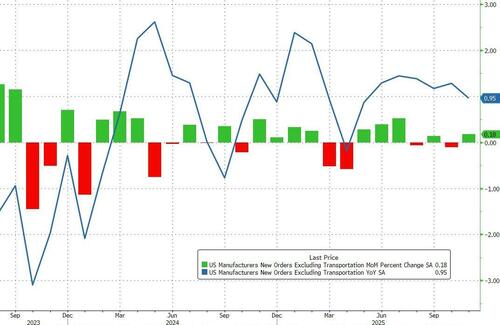
    Core Orders (ex transportation) rose 0.2% MoM, also rebounding from a 0.1% MoM decline in October…

    Source: Bloomberg

    The final print for Durable Goods Orders were all in line with the flash prints.

    Of course, this data remains significantly stale (and we face the possibility of another government shutdown to screw things up again), but overall, the trend is your friend (and supported by strong jobless claims data).

    Loading recommendations…
  • Trump Says John Deere Will Invest $70 Million To Build Excavator Factory In North Carolina

    Trump Says John Deere Will Invest $70 Million To Build Excavator Factory In North Carolina

    Authored by Aldgra Fredly via The Epoch Times (emphasis ours),

    President Donald Trump announced on Jan. 27 that farm equipment maker John Deere will invest $70 million to build an excavator factory in North Carolina.

    A John Deere excavator piles road salt in preparation for a winter storm at the Boston Public Works Department yard in Boston on Jan. 28, 2022. Scott Eisen/Getty Images

    “It’s brand new, the best in the world. And I think it’s going to pay off very, very big,” the president said during an event in Iowa. “We don’t make them here. This is going to be the only excavator entirely made in the United States of America.

    The White House later said in a post on X that John Deere will build two new factories in the United States, including one in North Carolina that will help “move excavator production BACK to America.”

    The second factory is a state-of-the-art distribution center, which will be built near Hebron, Indiana, the company said in a Jan. 27 statement. Both facilities are expected to open next year, it said.

    John Deere said the North Carolina plant will manufacture excavators previously produced in Japan and will employ more than 150 workers when it opens.

    The company said that it has broken ground on the Indiana project, a facility designed to streamline John Deere’s operations and ensure the timely delivery of equipment and parts. The project is expected to generate about 150 jobs, it added.

    “Our investment in these new facilities underscores John Deere’s dedication to strengthening the backbone of American industry and supporting local economies,” John Deere CEO John May said. “We believe in building America, and these projects represent our intent to continue driving innovation and job creation in the United States.”

    John Deere said last year that it would invest $20 billion in the United States over the next decade, calling it “a powerful signal” of its long-term commitment to building and growing domestically.

    The company also made clear that it has no plans to shut down domestic manufacturing.

    Texas Department of Agriculture Commissioner Sid Miller speaks to The Epoch Times in Irving, Texas, on Sept. 22, 2023. Samira Bouaou/The Epoch Times

    Texas Agriculture Commissioner Sid Miller welcomed the move on Jan. 27 and expressed hope that John Deere would choose Texas as the site to build its next factory.

    “I applaud President Donald J. Trump for standing up for American workers and bringing manufacturing back home. John Deere’s decision to build new factories in the United States is a win for our economy, our workforce, and our national security,” Miller said in a post on Facebook.

    This is the kind of leadership that puts America first and rebuilds our industrial strength. Now let’s keep that momentum going and make sure the next one is built right here in Texas.”

    Loading recommendations…
  • One, Big, Beautiful Refund: How The $1000 Jump In Tax Refunds Will Impact Consumers

    One, Big, Beautiful Refund: How The $1000 Jump In Tax Refunds Will Impact Consumers

    Given poor consumer sentiment (which earlier today supposedly tumbled to a 12 year low, just in time for a new record high in stocks) and fears around a “K-shaped” economy, the Trump administration has been focused on announcing new policies aimed at “increasing affordability,

  • Winter Storm Fern To Lower Q1 GDP By 0.5% To 1.5%

    Winter Storm Fern To Lower Q1 GDP By 0.5% To 1.5%

    Winter storm Fern is mostly over, its resulting damage, however, will linger for a long time.

    To assess the economic impact of the brutal winter storm, BofA chief economist Aditya Bhave looked back at Winter Storm Viola, which hit the US in February 2021. Both storms put roughly half the country under a winter weather advisory. Consumer spending fell by 0.9% m/m in February 2021, after a 1.3% increase in January. However, this swing probably wasn’t entirely due to Viola: January 2021 spending was also boosted by the passage of the CAA in December 2020, and favorable seasonal adjustments. 

    In his analysis Bhave used the latest BofA aggregated credit and debit card data (report available to pro subs) to zoom in on the effect of Viola. Total card spending was down 3.7% y/y in the week ending February 19, 2021, compared to a trend of about +6% y/y in prior weeks.

    Accounting for a pickup in card spending growth in the weeks after the storm, the BofA economist estimates that at least 0.6% of spending was lost over a one-month period due to Viola. That’s a little more than a quarter of the Jan-Feb swing in total consumer spending, and works out to about a 0.5% drag on Q1 2021 GDP growth.

    The slowdown in total spending due to Viola might have been larger than the impact on BAC card spending, because cash transactions would most likely have taken a bigger hit. Moreover, some of the rebound in spending growth after Viola might have happened for other reasons. Finally, the bank’s estimate above only looks at spending: other components of GDP would also have been affected by Viola.

    Accounting for these factors, Bank of America thinks the headwind to Q1 2021 GDP growth from Viola might have been as large as 1.5%, which means that with strategist consensus expecting a roughly 1.5%-2% growth in Q1 before the winter storm, the US economy may be stagnant in the first quarter.

    That said, the analogy isn’t perfect as Viola caused significant damage in the South, with extended disruptions to the power grid in Texas. It now appears that Winter Storm Fern won’t be as disruptive, partly because the region is now better prepared. But Fern has resulted in a lot more snowfall in the Northeast, which has a larger concentration of higher-income HHs. So it isn’t clear whether Fern will cause more or less economic damage than Viola.

    In any case, BofA’s initial estimate is that the drag on Q1 2026 growth will be in the range of 0.5-1.5%.

    The good news is that the bank does not expect any lasting impact on the trajectory of the economy. This means there is as much upside to 2Q GDP growth as there is downside to 1Q.

    Loading recommendations…
  • Trump Threatens To Raise Tariffs On South Korean Goods To 25%; Won Slides

    Trump Threatens To Raise Tariffs On South Korean Goods To 25%; Won Slides

    Here we go again. 

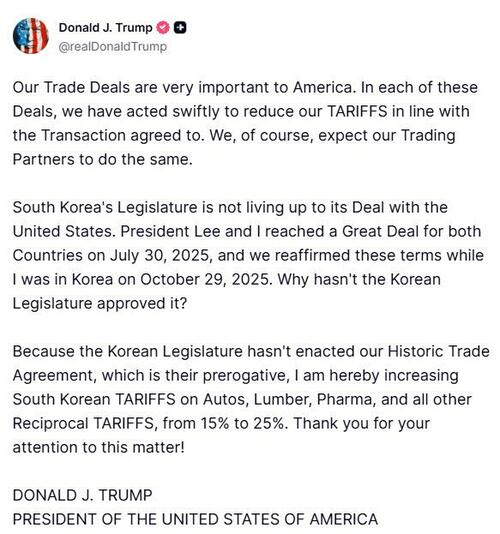
    President Trump threatened to hike tariffs on goods from South Korea to 25% from 15%, citing in a Truth Social post what he said was the failure of the country’s legislature to codify the trade deal the two nations reached last year, a failure which was obvious from miles away as the terms of the trade deal require Korea to invest hundreds of billions – which it doesn’t have – in the US.

    The new rate would apply to autos, lumber, pharmaceutical products and “all other Reciprocal TARIFFS,” he wrote in a social media post. It probably would not apply to memory chips which are already the most expensive thing on plant earth, at least until the RAM producing cartel starts to, well, producing RAM again.

    If implemented, the move could have wide-ranging effects on major South Korean companies that export to the US, such as Hyundai Motor, which sent 1.1 million vehicles to America in 2024. 

    As Bloomberg notes, Trump’s announcement marks his latest move to ratchet up trade tensions with allies. In recent weeks, he has threatened to raise duties on Canadian products to 100% if Ottawa signed a trade deal with China (it then promptly said it would not) and to slap new charges on European countries’ goods over his quest to seize control of Greenland.

    The USDKRW gapped up 0.7% to 1452 on the news, amid thin liquidity before the local market open.

    Loading recommendations…
  • The Fatal Limits Of The Technocrat Class

    The Fatal Limits Of The Technocrat Class

    Authored by Charles Hugh Smith via OfTwoMinds blog,

    Goliath dies not because collapse occurs, but because scale mistakes itself for life. What survives was never his.

    This guest essay by longtime correspondent 0bserver speaks to a dynamic woven into all of my work: the intrinsic impossibility of fixing what technocratic management broke with more technocratic management. Attempts to do so result in doing more of what’s failed, with fatal consequences for the systems being “fixed,” as the technocratic elite holds the power to impose policies but is immune to the consequences of the failure of those policies. Those fall on the system, which then veers into incoherence and Model Collapse.

    I’ve been reading Luke Kemp’s Goliath’s Curse: The History and Future of Societal Collapse with care, because the book is serious, well-researched, and written from within institutions that spend their days thinking about systemic fragility. Kemp is not unserious, nor is he shallow. His diagnosis of elite failure, complexity, inequality, and institutional overreach aligns with much of what many of us have been warning about for years.

    Where I think the book ultimately fails, however, is not in what it sees–but in what it cannot see from the altitude at which it operates.

    Kemp’s collapse framework is managerial. Collapse is treated as a system-level pathology to be prevented through coordination, governance, and institutional reform. This makes sense given his professional formation and affiliations, but it creates a blind spot that becomes more consequential the longer one reads: continuity is assumed, not explained.

    The book speaks fluently about sustainability, inequality, elite capture, and long-term risk. Yet it does not seriously engage with inheritance–not inheritance as wealth alone, but inheritance as transmission: skills, trades, family structure, norms, fertility, competence, and responsibility carried forward across generations. Sustainability is framed as system stability rather than generational renewal.

    This omission matters, because collapse is not the absence of order. It is the failure of particular scales of organization. When large institutions fail, life does not disappear–it reorganizes. The question is not whether systems can be stabilized indefinitely, but whether anything capable of inheritance remains when stabilization fails.

    Luke Kemp is excellent at identifying fragility in centralized systems. He is far less interested in, or perhaps less equipped to examine, the base-rate reality that most societies muddle through breakdowns via informal order, households, and local competence. This is where pessimism overweights evidence. Failure is dramatic and legible; endurance is quiet and distributed.

    Where this becomes decisive is in Kemp’s proposed solutions.

    When collapse looms, the remedies offered are more coordination, better governance, stronger institutions, improved global frameworks, and smarter management of risk. Complexity is to be handled by expertise; inequality by policy; instability by coordination. The scale that failed is asked to save itself.

    This is the core problem.

    The solutions operate at the same level as the failure.

    Centralization is offered as the cure for overextension.

    Governance is offered as the cure for institutional fragility.

    Coordination is offered as the cure for complexity.

    The very mechanisms meant to prevent collapse amplify its consequences when they fail.

    Recent history supplies proof–not theory.

    The financial collapse of 2008 rescued banks while households absorbed the loss. Large institutions were recapitalized immediately; families lost homes, savings, and years of accumulated effort. Recovery was declared long before household continuity returned.

    The pandemic reinforced the same pattern. Large corporations were deemed essential, while small and local businesses were declared nonessential and shuttered. Compliance favored scale; capital consolidated upward; independent capacity quietly disappeared.

    A third proof is now unfolding without crisis declarations. Large banks continue to grow while private equity consolidates trades and local services–plumbing, HVAC, electrical, veterinary clinics, small manufacturing. Businesses are bought, debt-loaded, stripped, and optimized for extraction. Ownership disappears, stewardship evaporates, and nothing is left to inherit when failure arrives.

    These outcomes are not policy accidents.

    They are the predictable result of scale-first solutions.

    Systems are stabilized.

    Households are tested.

    Continuity bears the cost.

    What troubles me most is that Goliath’s Curse critiques elites and inequality while failing to recognize how insulated analysis itself has become. Collapse expertise that cannot be lived becomes abstract. Risk is modeled without skin in the game. Moral urgency is asserted without moral grounding. The book makes moral claims–about obligation, responsibility, and injustice–without ever naming the source of those obligations.

    This creates a quiet contradiction. Moral language is necessary to motivate coordination, but moral foundations are left ambiguous to preserve managerial flexibility. In the absence of grounding, obligation eventually collapses into power.

    Nassim Nicholas Taleb has a name for one failure mode here: the intellectual yet idiot–not stupid, not malicious, but insulated from consequence. I don’t think Luke Kemp himself is the target. The framework is. Collapse theory that remains legible only to institutions will always propose institutional solutions, even when the problem has already migrated below that level.

    The real threat is not collapse per se. Systems rise and fall. The real threat is the dissolution of the family and the erosion of inheritance.

    Institutions can be recapitalized. Markets can reprice. States can fragment and re-form. Families cannot be substituted.

    When families fail to reproduce competence, culture, and responsibility across generations, nothing downstream inherits. What follows is not collapse but vacancy.

    Goliath dies not because collapse occurs, but because scale mistakes itself for life. What survives was never his.

    That is the argument I think Goliath’s Curse gestures toward but cannot complete from where it stands. The book diagnoses fragility well. It does not yet explain endurance.

    And in the end, endurance–not prevention–is what decides the future.

    This is a guest essay by longtime correspondent 0bserver.

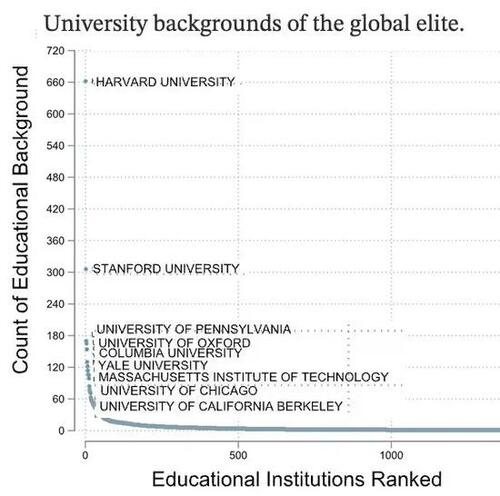
    CHS here: note that the global technocrat elite follows a power law distribution in where they attended university:

    …and the power they wield in markets and institutions:

    *  *  *

    My new book Investing In Revolution is available at a 10% discount ($18 for the paperback, $24 for the hardcover and $8.95 for the ebook edition). Introduction (free)

    Check out my updated Books and FilmsBecome a $3/month patron of my work via patreon.comSubscribe to my Substack for free

    Loading recommendations…
  • Core Durable Goods Orders Rise For 8th Straight Month

    Core Durable Goods Orders Rise For 8th Straight Month

    US Durable Goods Orders soared 5.3% MoM in (admittedly very lagged due to the shutdown) preliminary November data (significantly exceeding the 4.0% MoM expected and a major rebound from October’s 2.1% MoM decline), boosted by bookings for commercial aircraft and other capital equipment.

    Source: Bloomberg

    That big jump (the biggest in six months) pushed durable goods orders up 10.5% YoY – the 3rd biggest increase since June 2022.

    Under the hood, non-defense aircraft spend soared, defense spending dipped and motor vehicle orders were flatish…

    Source: Bloomberg

    Meanwhile, Core Orders (ex Transportation) rose 0.5% MoM (also better than expected)…

    Source: Bloomberg

    This was the 8th straight month of increases, leading to a 4.4% YoY rise in orders – the best since October 2022.

    The data out Monday also showed the value of core capital goods orders, a proxy for investment in equipment that excludes aircraft and military hardware, increased a larger-than-forecast 0.7%.


    Loading recommendations…