Blog

  • India Is Set To Be The G20 Growth Leader In 2026

    India Is Set To Be The G20 Growth Leader In 2026

    The latest OECD Economic Outlook (December 2025) revealed that the global economy has proved resilient last year, even though fragilities remain, with a range of risks including “elevated policy uncertainty and rising barriers to trade”.

    According to the organization’s forecasts, global GDP growth is projected to slow down from 3.2 percent in 2025 to 2.9 percent in 2026.

    As Tristan Gaudiat shows in the infographic below, among G20 economies (together accounting for around 80 percent of global GDP), some countries are expected to continue growing at a pace well above the average.

    You will find more infographics at Statista

    India tops the list, with a real GDP growth expected to exceed 6 percent again this year (6.7 in 2025; 6.2 in 2026), driven by robust domestic demand, digital transformation and manufacturing growth.

    Indonesia follows at 5.0 percent (rate in 2025 and 2026), leveraging its young workforce and commodity exports.

    China, though facing structural slowdowns, remains a key player with 4.4 percent economic growth projected this year (after 5.0 percent in 2025).

    Saudi Arabia follows closely at 4.0 percent, buoyed by oil revenues and ambitious economic diversification efforts under the “Vision 2030” national plan.

    Loading recommendations…
  • | Zero Hedge

    | Zero Hedge

    Some parts of the website aren’t working as expected. We’re on it, please check back soon.

  • Germany’s Deindustrialization: Capital Flight, Green Policy, And The Point Of No Return

    Germany’s Deindustrialization: Capital Flight, Green Policy, And The Point Of No Return

    Submitted by Thomas Kolbe

    The German Chamber of Industry and Commerce (DIHK) sees the German economy in a prolonged phase of deindustrialization. Together with the Federation of German Industries (BDI), the chamber reiterates calls for far-reaching reforms to boost growth and investment. Yet both associations still shy away from touching the golden calf of the green transformation.

    Germany’s economic crisis continues into the new year without interruption. A survey conducted by the DIHK among 23,000 member companies found that only one in six firms expects an economic upswing in 2026.

    Twenty-five percent of companies are planning further job cuts, and only one third intend to make growth investments. For DIHK President Helena Melnikov, the situation is dramatic. If policymakers fail to act decisively, Germany faces a further massive loss of value creation and jobs, Melnikov warns. As before, the DIHK locates the core of the economic decline in German industry. According to chamber calculations, the sector has shed around 400,000 jobs since 2019.

    This weighs particularly heavily because these positions are typically well-paid and highly skilled. Their value creation reverberates throughout Germany’s economic structure—among industry-related services, regional trade, and ultimately public finances.

    As a result, municipal treasurers in industrial crisis hubs are increasingly confronted with insoluble challenges amid growing budget deficits. In cities such as Stuttgart, Erlangen, Wolfsburg, and elsewhere, business tax revenues are now visibly shrinking.

    Reality Denied

    Existing reforms are failing to reach companies, Melnikov warns, pointing to high labor and energy costs. The BDI likewise called 2026 a “year of reforms” in comments to Reuters.

    All of this is correct. And yet the question remains why leading figures of German business still lack the courage to openly criticize government policy and finally bury the visibly failed project of greening German society.

    We are witnessing a monumental failure of the economic elite—if it can even still be called that. The deindustrialization diagnosed by Melnikov is simply denied by large parts of the mainstream press as well as by policymakers. And yet the numbers speak clearly.

    It is not yet fully clear how large capital outflows were last year. In 2024, net direct investment outflows amounted to €64.5 billion; in 2023 they exceeded €100 billion. Previous years were likewise marked by sustained capital flight.

    Those who can are heading for the exits—fleeing green regulatory policy, high fiscal burdens, and the economic devastation inflicted on companies by Germany’s energy transition.

    Calls for sweeping reductions in bureaucracy also naturally feature on the list of location weaknesses. A perennial political evergreen—and a hollow demand in light of the massively increased pace of state intervention. The state will have to create tens of thousands of new public-sector jobs, at its development banks such as KfW and the state banks, in order to weave the flood of cheap credit into the arteries of the economy.

    On massive state intervention, business prefers to remain silent. Companies take what they can get. There is no talk of criticizing market distortions or the systematic crowding-out of the private sector from capital markets by the state.

    For the current year, the DIHK expects officially reported GDP growth of 0.7 percent. However, this figure includes net new public borrowing—including special funds—of around 5.5 percent, with a state share exceeding 50 percent of GDP. The private sector, by contrast, is likely to shrink by roughly four percent.

    Political room for maneuver is narrowing. Flight to the capital markets appears to be the last remaining way to buy time and maintain the illusion of social and economic stability through ever new subsidy programs.

    Location Patriotism Meets Reality

    And before the first patriotic crocodile tears are shed: every plant manager, CEO, capital-rich fund, individual investor, and family office will have carefully weighed its judgment on the destructive political framework conditions in Germany and the EU—and will not turn away from the location without reason.

    Insisting on location patriotism, after decades of deliberate erosion of patriotic sentiment, German traditions, and culture by the political apparatus and its associated media empire, is at best infantilizing—more bluntly put: cynical.

    Federal Chancellor Friedrich Merz and his finance minister Lars Klingbeil, for their part, have not hesitated in the past to play the patriotism card more or less openly when it came to the accelerating departure of German companies.

    In October, Klingbeil, in a display of helplessness, publicly called on business at the IGBC trade union congress in Hanover to commit to the location and safeguard jobs.

    A cheap media stunt, as Klingbeil is fully aware that energy-intensive production can no longer be defended at the German location, and that the policy of green transformation deliberately and systematically pushes industrial production abroad—or increasingly into insolvency.

    The narrative of a lack of loyalty to the location is now firmly established. It shows that politics has already identified its scapegoats—entrepreneurs and investors who are to be publicly blamed for the country’s economic decline. They are henceforth portrayed as irresponsible profiteers abandoning employees, society, and the community in the pursuit of supposed profit maximization.

    The depth of the ongoing recession and the now unmistakable deindustrialization of the country make it increasingly likely, week by week, that a point of no return—an economic tipping point—has already been crossed.

    German society is therefore left with essentially two options. Either it falls for the rhetorical tricks of the central planners around Friedrich Merz and Lars Klingbeil, accepts further nationalization and the construction of centrally planned artificial economies such as a war economy or a leaden eco-industry. Or it eventually broadens its horizon, returns to the principles of the free market economy, and accepts the social pain that any genuine transformation for the better must necessarily entail at the outset.

    * * * 

    About the author: Thomas Kolbe, born in 1978 in Neuss/ Germany, is a graduate economist. For over 25 years, he has worked as a journalist and media producer for clients from various industries and business associations. As a publicist, he focuses on economic processes and observes geopolitical events from the perspective of the capital markets. His publications follow a philosophy that focuses on the individual and their right to self-determination.


    Loading recommendations…
  • Germany’s Chancellor Warns Of Economic Collapse… Then Doubles Down On Central Planning

    Germany’s Chancellor Warns Of Economic Collapse… Then Doubles Down On Central Planning

    Submitted by Thomas Kolbe

    In a letter to members of the governing coalition that has so far only become known in fragments, Chancellor Friedrich Merz warns of a severe economic crisis and calls for reforms. Yet the circulating and quotable elements of the document from the Chancellery reveal no deviation whatsoever from the course already taken.

    Friedrich Merz begins the new year with party-internal messaging. In a letter to members of the governing coalition of the Union parties and the SPD—so far known only in excerpts—the chancellor invokes a common struggle against the economic crisis. Once again, he calls for a “year of reforms,” after the loudly announced “autumn of reforms” last year slipped through his fingers like sand.

    Once again, Merz risks seeing a rhetorical initiative dissipate in the void of coalition dynamics—dynamics that, under the dogma of firewall politics, are pushing his government ever deeper into ideological waters that even Social Democrats of the old Helmut Schmidt school would likely consider unacceptably far to the left of economic reason.

    The Miracle of Realization

    In his letter, Merz warns—while a tremor of startled realization is almost palpable—that dangerous job losses have set in across all sectors and that the situation is dramatic. It is, he writes, high time to enable new growth through better location conditions and to prevent the labor market from tipping over. In short: more competition, more growth, less bureaucracy, lower energy costs.

    A profound insight, one that seems to have come over the chancellor as if in a fever dream of his ecologically ambitious “dream Germany.”

    It is not as if commentators and industry have not been discussing the causes of deindustrialization and the catastrophic state of the economy for years. But the ideological opinion bubble in Berlin—the tightly drawn belt of NGOs and government-affiliated, sympathetic media—has done its job, preserving within political circles the illusion of success of the green transformation.

    How could it be that an economic crisis lasting more than seven years—beginning in the core sectors of German industry and now seeping deep into the entire economy—has only now arrived at the Chancellery with such urgency? That Germany has long been caught in a spiral of deindustrialization is no new insight. It was triggered by an ideologically driven green transformation, by overregulation and fiscal overburdening. To Merz’s credit, he has recognized this. His solution, however: further subsidies for collapsing, politically promoted green structures; subsidies for media-powerful big industry; slogans of endurance—and scolding of the Mittelstand.

    Yet even this supposedly simple diagnosis remains incomplete, misunderstood, and carefully obscured. In the known passages of the letter, there is not a word about the migration chaos that for a decade has dragged down social security systems like lead and shaken internal security. Not a word about the naive belief that complex economies can be steered toward a green planned economy in the style of Robert Habeck. Not a word about the fact that Germany’s welfare state has produced tax and contribution burdens that are no longer internationally competitive.

    From the looming catastrophe in the Donbas, the chancellor derives nothing more than unwavering loyalty to Kyiv—whatever the cost. After all, it is not his money.

    Coalition Without Course Correction

    Friedrich Merz already demonstrated last year that, if in doubt, he is prepared to make any concession necessary to preserve his coalition. One need only recall the relabeling of “citizen’s income” into the largely unchanged “basic security”—no one need fear financial cuts if, after skipping appointments twice, they manage to report in time to the relevant welfare administration office for full social provisioning.

    The debate about a genuine migration turnaround, about deportations of illegal migrants, has been completely smothered. Instead, we witness media-friendly individual actions designed to conceal the fact that Merz, Klingbeil, and their allies agree on the fundamentals: the EU Commission’s course toward a net-zero economy and a policy of open borders are to be continued—whatever the cost.

    We are well acquainted with the missing diagnosis and the formulaic solutions: cutting bureaucracy, subsidized industrial electricity prices, a corporate tax cut vaguely promised for 2028. All of this amounts to little more than white ointment. The real ideological hammers—from the Supply Chain Act to the Heating Act and the recently increased CO₂ levy—are being defended with full force.

    Taxpayers and the Mittelstand are being bled in the hope of eventually reaching a green Elysium. Merz sees the state as the decisive player in the economy. Key sectors are to be fully controlled: from green cultural industries to the newly expanding military sector to basic materials—naturally dressed in the green costume of long-failed products like “green steel.” This direction is shared by the German government’s partners in Paris and Brussels.

    The fatal belief in the omniscience of the central planner is dragging the country downward like lead.

    Capital Flight as a Vote With the Feet

    It is remarkable with what chutzpah Friedrich Merz repeatedly points to tax cuts and investment incentives—and to alleged preparatory work by the coalition last year. We have heard it all before. In the end, it is always entrepreneurs who are blamed for the decline. That nothing moves in Germany, of course, has nothing to do with the Kafkaesque overregulation that alone in the past three years forced the economy to create 325,000 new jobs merely to cope with new regulatory requirements.

    The hyper-state is overflowing, growing obese, and now outsourcing its tentacular bureaucratic labor.

    In reality, capital is voting with its feet. Year after year, Germany loses between €60 and €100 billion in net direct investment. This is no coincidence but a clear verdict on the catastrophic conditions at the location.

    As an answer to this state-engineered bloodletting of the economy, the chancellor presents his so-called “Germany Fund”: a state investment fund intended to channel private capital into allegedly promising growth sectors. More planned economy, this time in the guise of innovation promotion. Capital allocation by political decree.

    The self-inflicted debt crisis, triggered by the dismantling of the debt brake, is conveniently ignored by Merz in his letter—future generations of politicians and taxpayers will have to deal with that disaster.

    “Germany Fund”—when things get uncomfortable, the same political class that otherwise categorically rejects any national reference suddenly reaches for patriotic symbols. A transparent maneuver that fits seamlessly into the media games of the Chancellery: from the corporate coffee klatch “Made for Germany” (as Apollo News reported) to appeals to entrepreneurs to invest in Germany after supposedly brilliant political groundwork. Merz repeatedly stages himself as a business-friendly chancellor—apparently unaware that credibility and trust have long since been squandered.

    Friedrich Merz acts like a central planner without an ordoliberal compass. His time as a ceremonial executive at BlackRock seems not to have granted him access to the secret knowledge of market processes. Perhaps he should have gone to school with the much-maligned Javier Milei to understand that an ecological restructuring of the economy according to a state master plan is doomed to fail.

    In the next circular, Merz will likely roll out his familiar catalogue of endurance slogans and Mittelstand platitudes—buying time in what is becoming an unavoidable fight against decline.

    * * * 

    About the author: Thomas Kolbe, born in 1978 in Neuss/ Germany, is a graduate economist. For over 25 years, he has worked as a journalist and media producer for clients from various industries and business associations. As a publicist, he focuses on economic processes and observes geopolitical events from the perspective of the capital markets. His publications follow a philosophy that focuses on the individual and their right to self-determination.

    Loading recommendations…
  • Perhaps We Should Actually Be Focusing On Fixing America

    Perhaps We Should Actually Be Focusing On Fixing America

    Authored by Michael Snyder via TheMostImportantNews.com,

    After years of heading in the wrong direction, nobody can deny that the United States is facing overwhelming problems. So why don’t we focus on fixing those problems first? The truth is that we can’t do everything because our resources are very limited. U.S. households are more than 18 trillion dollars in debt, and the federal government is more than 38 trillion dollars in debt.

    Even though we have literally stolen trillions upon trillions of dollars from future generations, our major cities are rapidly decaying, our infrastructure is crumbling, corruption is rampant, the middle class is shrinking, most of the population is struggling to even afford the basics each month, mass layoffs are happening all over the nation, our streets are teeming with hordes of drug addicts and homeless people, large numbers of Americans are selling images of themselves online just to make ends meet, and millions of others are living in their vehicles.

    So why don’t we use what limited resources we have to fix our own problems?

    If you don’t understand the point that I am trying to make, just go take a stroll through downtown Seattle.

    The new mayor has decided that it will be her policy to allow people to openly do drugs in the streets

    Seattle’s new ultra-woke mayor has triggered chaos by ordering police not to arrest people doing drugs on the streets of the city plagued by crime and homelessness.

    Democratic socialist Katie Wilson, 43, was sworn in as the city’s 58th mayor on Friday.

    The progressive politician who co-founded the Transit Riders Union has already taken steps that concerned residents and law enforcement officials say will destroy Seattle.

    The president of the Seattle Police Officers Guild, Mike Solan, is warning that this will make the lawlessness in the streets of Seattle even worse

    ‘We’ve all seen how our streets can be filled with death, decay, blight and crime when ideology like this infects our city, Solan continued in his statement.

    ‘Now with this resurrected insane direction, death, destruction and more human suffering will be supercharged.’

    Lawmakers and residents have reacted to this news in horror, as the city already has a raging homelessness epidemic that they believe this lax drug policy will only amplify.

    Once upon a time, Seattle was one of the most beautiful cities on the entire planet.

    So what in the world happened?

    Of course it isn’t just Seattle that has been transformed into a crime-ridden, drug-infested hellhole.

    All over the nation, chaos reigns in the streets of major American cities.

    In fact, last night a “hammer-wielding maniac” destroyed a bunch of windows at the Cincinnati home of Vice President J.D. Vance…

    A hammer-wielding maniac who smashed four windows at JD Vance’s Cincinnati home has been arrested by the Secret Service after an overnight break-in.

    William DeFoor, 26, was charged early Monday morning with one count each of obstructing official business, criminal damaging or endangering, criminal trespass and vandalism.

    Secret Service agents heard a loud noise at the home around midnight and spotted DeFoor running from the home, which is the secondary residence for Vance, his wife Usha and their three young children, who were out of town at the time.

    Meanwhile, lawlessness also continues to run rampant in high places all over the country.

    So what is being done about it?

    After all this time, how many corrupt members of past administrations have been arrested and put in prison?

    After all this time, how many corrupt corporate executives have been arrested and put in prison?

    After all this time, how many of Jeffrey Epstein’s associates that also sexually abused young girls have been arrested and put in prison?

    How can we tell the rest of the world how they should be doing things when we can’t even get our own house in order?

    We have been getting hit by crisis after crisis, and economic conditions are steadily deteriorating.

    In fact, we just learned that U.S. manufacturing activity has contracted for a 10th consecutive month

    US manufacturing activity contracted for a 10th straight month in December, a survey indicated Monday, pointing to a continued drag in sentiment from tariffs and trade policy uncertainty.

    The Institute for Supply Management’s (ISM) manufacturing index fell to 47.9 from November’s 48.2 reading, the lowest of 2025 despite modest improvements in employment and some other categories.

    Our artificially-inflated stock market continues to hover near record highs, but at the same time the number of large corporations that are going bankrupt just continues to rise

    Between January and November 2025, at least 717 companies filed for Chapter 7 or Chapter 11 bankruptcy, according to data from S&P reviewed by The Washington Post.

    That marks a 14% jump compared to the same period in 2024, and the most filings seen since 2010, the tail end of the Great Recession.

    According to the Daily Mail, we are also seeing a very alarming surge in bankruptcies among small businesses too…

    A frightening recession indicator is flashing red — and Americans can see it all over Main Street.

    Experts told the Daily Mail that a sudden surge in bankruptcies and store closures — hitting mom-and-pop shops, small restaurants, and local retailers — could be an early warning sign that the economy is starting to crack.

    One expert that was interviewed by the Daily Mail is warning that this surge in bankruptcies is a clear indication that a recession is coming

    ‘The little guys are going to start falling first,’ Joe Barsalona, a Delaware-based bankruptcy lawyer at Pashman Stein Walder Hayden, said.

    ‘A recession is coming. I agree with economists that the increase in small business bankruptcies is a canary in a coal mine.’

    Of course many would argue that a recession is already here.

    In recent months, I have written a lot about the mass layoffs that have been occurring all over the country.

    Well, now Newsweek is reporting that over 100 companies have filed WARN notices for mass layoffs that will be taking place in January…

    More than 100 companies have filed WARN notices indicating plans to lay off workers in January 2026, according to WARNTracker.com. The following companies have filed a notice.

    I tried to warn my readers that a tsunami of layoffs was coming.

    Now it is here.

    The following is the full list of 119 companies that have filed WARN notices for this month…

    • AARP
    • AbbVie
    • Adams County Public Hospital
    • AeroFarms1526 Cane Creek
    • Amazon
    • Amentum
    • American Signature, Inc.
    • Apogee Architectural Metals
    • Archer Daniels Midland Company
    • Atkore Plastics Southeast
    • Augusta Sportswear, Inc.
    • Bechtel National Inc.
    • Best Dressed Chicken, Inc.
    • Blue Plate Oysterette LLC
    • Blue Shield of California
    • Bond 45 National Harbor Restaurant
    • Braga Fresh Foods, LLC
    • Building Materials Manufacturing LLC
    • BWW Law Group, LLC
    • Catalent, Maryland, Inc.
    • Charles River Laboratories
    • Clari Inc.
    • CNO Financial Group
    • Colonial Savings, F.A.
    • ColWyo Coal Company LP
    • CommUnify
    • Consolidated Hospitality Supplies
    • Corteva
    • CoStar Group
    • Couchbase, Inc.
    • CRST Expedited, Inc.
    • Dental Benefit Management, Inc.
    • Dillard’s Inc.
    • Dometic Corporation
    • DRT, LLC
    • DSV Air & Sea Inc.
    • enDevelopment Logistics, LLC
    • FedEx
    • FreshRealm
    • Fresno Economic Opportunities Commission
    • Galleher LLC
    • General Motors
    • Giesecke + Devrient ePayments America Inc
    • Gilead Sciences
    • Grand Lux Café, LLC
    • Great Floors
    • H&M Fashion USA, Inc.
    • HD Supply
    • Heibar Installations Inc.
    • Henkel Corporation
    • HRL Laboratories
    • Hudson
    • Huntington National Bank
    • Illumina
    • ImmunityBio
    • Inline Plastics
    • Institute of International Education
    • International Paper
    • Invincible Boat Company
    • Kloeckner Meals
    • Lakeshore Learning Materials, LLC
    • Louis Vuitton USA Inc.
    • Lumileds
    • Maritime Applied Physics Corporation
    • Marshalls of CA, LLC
    • Mattel
    • McDonald’s
    • MDWise
    • Meteorcomm LLC
    • Mettler-Toledo Rainin, LLC
    • Michigan Sugar Company
    • Middlebury Institute of International Studies at Monterey
    • Nationstar Mortgage, LLC
    • NIKE Retail Services, Inc.
    • Nordstrom Portland Rack
    • Ojai Valley Inn
    • Palo Verde Hospital
    • Panasonic Well LLC
    • Peraton’s Environmental Integration Services III
    • Post Consumer Brands, LLC
    • Presbyterian Home for Central New York, Inc.
    • Providence Health & Services
    • Rad Power Bikes, Inc.
    • RATP Dev and Midtown Group
    • Raytheon Technologies
    • Rebel Restaurants, Inc.
    • Red Run Corporation T/A Food Depot
    • Regional Medical Center of Central Alabama
    • Retail Services WIS Corporation
    • Revity, Inc.
    • Roads Express, LLC
    • Saddle Creek Logistics Service
    • SC Industrial Holdings, LLC
    • SDH Education West, LLC
    • SDH Service East, LLC
    • Shell Recharge Solutions
    • SLO Brewing Co. LLC
    • Smokin Bear LLC
    • Smurfit Westrock
    • Sodexo
    • Spirit Airlines, LLC.
    • Synopsys, Inc.
    • Takeda Development Center Americas Inc.
    • Terzo Enterprises Incorporated
    • The Cheesecake Factory
    • The French Gourmet, Inc.
    • The Taubman Company
    • TJX Companies, Inc.
    • TransAlta
    • United Supermarkets
    • Van Law Food Products, Inc.
    • Verizon
    • Virginia Mason Franciscan
    • Warner Music Group
    • Wells Fargo
    • West Fraser, Inc.
    • White Coffee Corporation
    • WIS International
    • WWL Vehicle Services America, Inc.

    That is quite a long list, isn’t it?

    The American people are not stupid.

    They can see what is happening, and one recent survey found that 52 percent of U.S. adults actually believe that a recession has already started…

    According to the ARG data, 52% of Americans believe the economy is already in a recession, and 64% say it’s getting worse.

    These numbers suggest that many Americans are feeling the squeeze, even if official metrics don’t yet reflect a recession.

    Only 11% think the economy is improving. Just 22% rate it as excellent, very good, or good, while 73% call it bad, very bad, or terrible, showing a clear gap between public sentiment and political narratives about economic strength.

    Looking ahead, 60% believe the national economy will be worse a year from now, and just 16% say it will be better.

    Yes, things are certainly bad now.

    But they are not even worth comparing to what is further down the road.

    So why don’t we use our limited resources to address the historic challenges that we are facing in our own nation?

    If we love this country, we should try to fix it.

    *  *  *

    Michael’s new book entitled “10 Prophetic Events That Are Coming Next” is available in paperback and for the Kindle on Amazon.com, and you can subscribe to his Substack newsletter at michaeltsnyder.substack.com.

    Loading recommendations…
  • Germany’s Middle Class Under Siege In 2026

    Germany’s Middle Class Under Siege In 2026

    Submitted by Thomas Kolbe

    Save in times of plenty, and you’ll have in times of need. An old German proverb, now proving tragically prophetic. The hardship caused by a completely derailed climate-socialist ideology is only just beginning. This socialist experiment is likely to continue ravaging the country until its economic substance is entirely consumed.

    The new year begins as the old one ended: a fiscal raid on the wallets of the middle class. In Brussels and Berlin, there is satisfaction that citizens have been quietly, without spectacle, subjected to yet more tax increases—whose revenues, like a rising tide, lift all ships only slightly.

    On January 1, the CO₂ price per ton of emitted gas rose from €55 to €65. This levy, applied to fossil fuels such as gasoline, diesel, natural gas, and heating oil, threads like a red line through the entire value chain—even reaching private households’ bills. The green extraction mechanism is now firmly entrenched, funding Brussels’ expanding activities increasingly, and is defended tooth and nail by the ruling politicians.

    The Lie of Tax Relief 

    When the federal government celebrates its minimal tax relief for lower- and middle-income groups, reality tells a different story. In truth, these relentless fiscal collectors are increasing the tax burden further. Only the distracting work of state-affiliated media prevents the growing hyperstate’s costs from becoming fully visible.

    2026 is set to become an expensive year for Germany’s shrinking middle class, visible soon on the first paycheck of the year. That will reveal the true cost of an overextended welfare state and the one-of-a-kind experiment of transforming Germany’s social insurance system into a quasi-global insurance scheme.

    Never since World War II has the German middle class faced such fiscal and economic pressure.

    The Burden of State Subsidies on the Middle Class 

    The countless subsidies and state interventions financing the complex “green arts” sector, the Ukraine war, and now the military buildup constitute a direct attack on the German middle class. Businesses and net taxpayers pay an ever-rising “blood price” each year to sustain Berlin’s and Brussels’ ideological and power ambitions.

    The still-active renewable energy subsidy program, the EEG, alone consumes over €16 billion this year for an energy grid that, since the end of nuclear power, no longer provides a secure base for industrial production, sending both industrial and household electricity costs to dizzying heights. Trittin’s “ice ball” has become a cost Himalaya no one can climb.

    Germany’s seven-year industrial decline, which is now accelerating, precisely chronicles the path of the deliberate destruction of its industrial base. Nearly 300,000 industrial jobs have been lost since 2018—tragic, yet apparently of little concern to Berlin’s policymakers.

    Local city treasurers, however, are feeling the pain: as corporate tax revenues collapse under industrial destruction, citizens can expect cuts in public services and steep tax hikes. Schools, kindergartens, sports facilities—all face drastic savings. A big “thank you” goes to Berlin central planning.

    Industry on the Edge: Loans Fizzle 

    What Friedrich Merz, Ursula von der Leyen, and other central planners aim for is clear: using state loans to occupy freed-up industrial capacities. Yet no matter how much funding flows into the new social program under the banner of a special fund for green and military production—the effect has already fizzled. In December, the entire Eurozone industrial sector, measured by current Purchasing Managers’ Indices (PMI), slipped into recession. Germany has been continuously downsizing its industry for seven years.

    A victory for Brussels’ central planners, whose goal appears to be the economic and geopolitical neutralization of the country. After years of deindustrialization and waves of bankruptcies, this strategy is hard to interpret otherwise. Germany’s PMI now sits at 47 points—clearly in contraction. Hundreds of thousands of jobs will be lost this year. Last year alone, 24,000 companies went bankrupt. Exact figures for job and net direct investment outflows are not yet available; in 2024, €64.5 billion flowed out of Germany. German industry is no longer competitive.

    Quick Blame Game 

    The culprits are quickly identified. U.S. tariffs, a favorite topic of sympathetic media, are often cited, though the crisis began long before Donald Trump. Dumping competition from China is also highlighted. While this is a factor, 99 percent of Germany’s economic problems are homegrown.

    No one forced the country to keep its borders wide open for a decade, pushing its social insurance to the brink of collapse—all to create new voter bases for the united political left and to break resistance from the bourgeois right.

    Shrinking Middle Class and Falling Investments 

    This trend is reflected in the middle class. The DATEV SME Index shows falling real revenues across all sectors, particularly trade, construction, and consumer services. Investments are nearly frozen: only 20 percent of companies plan rising investments, according to LBBW’s SME radar for the coming year.

    The ideological green agenda has left its mark. High electricity costs, falling incomes, and persistent inflation are bleeding the middle class dry. Retail felt this for the first time during Christmas: nominal sales rose 1.5 percent, yet real sales fell by 1 percent in the peak month.

    Economic stress will be a constant companion for Germany’s middle class in 2026. High property prices, zero real interest on savings, and rapid erosion of economic substance collide with an ever-expanding state. Bureaucracy and the state apparatus are evolving into a parasitic leviathan, funded by a shrinking number of contributors.

    Consequences for Industry, Trade, and City Centers 

    Too much depends on Germany’s high industrial value creation: service businesses, high factor incomes, and secure municipal finances—all are now being lost, reflected in city centers.

    Where once life flourished, roughly 5,000 retailers die every year, an irretrievable loss. The desolation mirrors what citizens feel in their wallets: the ebb has begun.

    The middle class’s evaporating purchasing power is most visible in hospitality, where families cut costs first. Hotels lost 3.7 percent in real revenue in 2025, while restaurants and bars fell 4.1 percent year-on-year. Households are saving wherever possible. High energy costs, rising social charges, and a weakening job market leave a trail of economic decline.

    Missed Lessons: The Population and the Crisis 

    Structural economic crises take time to penetrate public consciousness. Most households first tighten belts without complaint.

    The state exploits this calm before the storm to consume citizens’ wealth faster than the private sector can compensate. With net new debt over 5.5 percent this year—including accounting tricks—this is particularly evident. The devotion of a portion of the population to ideological doctrine becomes an expensive, destructive tragedy.

    Germany faces a nation unprepared to draw necessary lessons: reversing migration policy, adapting the bloated state apparatus to new economic realities, and downsizing accordingly. A turn toward a meritocratic market economy remains absent.

    Until these lessons are learned and acted upon, Germany will continue to fall.

    * * * 

    About the author: Thomas Kolbe, born in 1978 in Neuss/ Germany, is a graduate economist. For over 25 years, he has worked as a journalist and media producer for clients from various industries and business associations. As a publicist, he focuses on economic processes and observes geopolitical events from the perspective of the capital markets. His publications follow a philosophy that focuses on the individual and their right to self-determination.
    Loading recommendations…
  • US Manufacturing Sector Ends 2026 At Weakest In Over A Year

    US Manufacturing Sector Ends 2026 At Weakest In Over A Year

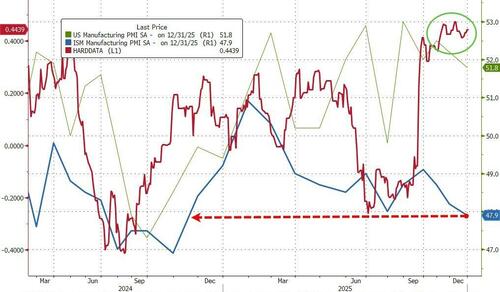
    The US Manufacturing sector ended 2026 on a down-note as yet another ‘soft’ survey data disappointed with ISM reporting at 47.9 (below the 48.4 expected) – the 10th consecutive month below 50 (contraction)…

    Source: Bloomberg

    Despite strong ‘hard’ data, that is the weakest print for ISM Manufacturing since Oct 2024.

    The decline in the measure reflected producers drawing down their raw materials inventories at the fastest rate since October 2024. That indicates many firms are relying on existing stockpiles to satisfy tepid demand.

    Plus, materials costs remain elevated.

    The ISM prices-paid index, which held at 58.5 last month, is 6 points higher than it was at the end of 2024.

    New orders contracted for a fourth month and export bookings remained weak, based on the ISM data. Headcount shrank for an eleventh straight month, albeit at a slower pace, amid modest production growth.

    The ISM’s gauge of imports shrank to a seven-month low, while supplier delivery times slowed and order backlogs continued to shrink.

    Respondents remain focused on the ‘t’ word…

    “Morale is very low across manufacturing in general. The cost of living is very high, and component costs are increasing with folks citing tariffs and other price increases. It’s cold in our area of the country, absenteeism is worse around the holidays, and sales were lower than we expected for November. So, things look a bit bleak overall.” [Electrical Equipment, Appliances & Components]

    “2025 revenue was down 17 percent due to tariffs. The lost revenue has inhibited our ability to offer bonuses to employees or create and hire for new positions.” [Miscellaneous Manufacturing]

    Things are quieter regarding tariffs, but prices for all products remain higher. Our costs have increased, so we have increased prices for our customers to compensate. Margins have deteriorated, as full pass through (of cost increases) is not possible.” [Computer & Electronic Products]

    “Winding up the year with mixed results. It has not been a great year. We have had some success holding the line on costs; however, real consumer spending is down and tariffs are ultimately to blame. I hope for some return to free trade, which is what consumers have ‘voted for’ with their spending.” [Chemical Products]

    “Trough conditions continue: depressed business activity, some seasonal but largely impacted by customer issues due to interest rates, tariffs, low oil commodity pricing and limited housing starts.” [Machinery]

    But looking ahead, abating tariff uncertainty and the passage of the One Big Beautiful Bill Act are anticipated to offer a tailwind to capital expenditures this year.

    Will the soft data catch up to the hard data? Or vice versa?

    Loading recommendations…
  • Germany’s Fiscal Illusion: Bond Markets Rebuke Merz’s Debt Spiral

    Germany’s Fiscal Illusion: Bond Markets Rebuke Merz’s Debt Spiral

    Submitted by Thomas Kolbe

    Germany was long seen as a bastion of fiscal stability in the Eurozone. But the erratic fiscal policy of the Merz government is now creating tensions in the bond market. Risk premiums on traditional periphery sovereigns like Italy, Portugal and Spain relative to German Bunds are shrinking.

    For months, something remarkable has been happening in European debt markets. Risk spreads on the key ten year sovereign bonds of countries such as Italy, Portugal and Spain versus the economic anchor Germany have been steadily falling. Spanish yields now sit only about 0.4 percentage points above German Bunds; Italian paper — from a country with around 125% debt to GDP — trades just about 0.7 points wider.

    Capital is clearly shifting out of Germany into other European bond segments. Is the market pricing in catastrophic German fiscal policy?

    Repricing German Policy 

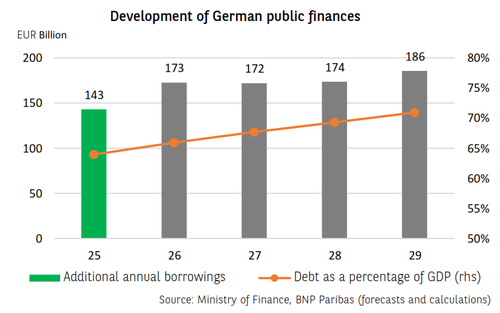
    Germany’s debt strategy is unmistakably being reassessed by markets. With the so called special fund, Berlin has effectively thrust the country into a debt spiral virtually overnight. Over the next decade, more than €850 billion in new debt is to be issued — on top of a core budget already running a 2.5 – 3% deficit.

    By decade’s end, Germany’s debt burden will likely hover near 85 – 90% of GDP — and nothing suggests an economic miracle will pull the nation out of this spiral. Miracles happen in fairy tales and children’s books — but even children’s book co author Robert Habeck didn’t achieve such an economic feat as Economics Minister.

    Implicit obligations from pension and social systems aren’t even factored in — in Germany or elsewhere. What matters in the move in bond yields isn’t the absolute level, but the relative jump in German indebtedness, and markets are pricing exactly that. All this meets an economic reality with no meaningful extra value creation. German policy is pumping state credit — which will later surface as higher taxes and inflation — into an economic vacuum, just like centrally planned systems do.

    Looking Ahead 

    Investors are watching German policy with hawkish scrutiny: the nuclear exit, sky high energy prices crushing industry, a migration policy that drains the welfare state like a vampire — all feed into German bund pricing. Bond markets are always a bet on the future — a judgment on national stability.

    The consequence is clear: yields are rising. And they’ll keep rising. A mounting debt pile becomes ever more expensive — that’s how markets must respond.

    These hard facts cannot be spun away by Kanzleramt spin doctors or orchestrated party media. German productivity has flatlined since 2018 — and is now declining. Industrial output has collapsed by about a fifth. Hundreds of thousands of manufacturing jobs have vanished while only the public sector expands, with the state’s share of the economy above 50%.

    Germany is gearing toward a wartime economy that yields near zero benefits for real economic output. Alongside an already failed “eco economy,” this parasitic sector consumes resources, fosters make work, and feeds a nexus of extraction firms. It’s funded by ever rising levies that increasingly burden productive workers. Prosperity and economic substance are being systematically — purposefully — undermined by central planners in Berlin and Brussels.

    This downward spiral is knowingly and ideologically accelerated by Chancellor Friedrich Merz’s government. The crisis is engineered as the solution — to bend the populace toward the climate socialist agenda and secure political power even as social stress rises. An ideological crash course — without doubt.

    What seems lost on climate socialist planners like Merz is this: economic action and potential prosperity fundamentally depend on cheap, reliable energy. Germany’s current crisis — productivity collapse and industrial decay — speaks for itself. It happened without necessity and stands in economic history as a unique act of self inflicted vandalism.

    That Merz and fellow climate socialists, using media plays, escalating censorship, and constant business bashing at events like employer forums, are trying to steer their political core through crisis shows only one thing: they fail to see this is a one way street. Climate socialism is the problem, not the solution — and markets along with German output are proving it.

    Yet this mindset is typical for career politicians trapped in ideological echo chambers. We saw this with Economics Minister Robert Habeck — a party functionary mythologized by state affirming green media, utterly unversed in economics, and intellectually overwhelmed. He failed to understand how the crisis of subsidized sectors he inflated with bailouts came about.

    Socialism is a recurring phenomenon in new guises. Climate socialism, like its predecessors, will fail through mass impoverishment. Harsh years lie ahead for Germany, and nothing seems able to prevent green vulgar socialism from metastasizing here. EU capitals have become adjunct outposts of Brussels’ cancerous core.

    Some shifts are already visible. Italy, for example, has begun transferring gold reserves from its central bank to state vaults and is pursuing independent energy security via North African gas. At the bond market, this is rewarded: yields and risk premiums there are falling. Investors apparently see Italy as a “First Survivor” in a severe Euro crisis. Germany has no similar narrative.

    Compounding this is Berlin’s almost unfathomable commitment to the Ukraine conflict without democratic mandate, accelerating fiscal decay. Merz plans to funnel around €11.5 billion from the 2026 federal budget directly into the Kiev black hole — a stance shared by Paris, London and Brussels — utterly detached from reality and dismissing even the possibility of a full U.S. pullback from the European theater.

    This geopolitical folly echoes in bond markets. Germany’s leaders are playing Vabanque — without historical sense, responsibility, or foresight.

    Those who hope that rising French and Belgian debt ratios (soon above 120% of GDP) can defuse hyper state growth via bond markets may be disappointed. Japan shows that even heavily domestically financed debt — at historically extreme ratios around 235% of GDP — can float for a while, though future obligations aren’t counted. Markets price in that the ECB will protect Eurozone debt by buying excess bonds — delaying collapse. But how exactly it intervenes now — since the “bazooka” of 2020 — is opaque and hidden. Risk premiums tell the tale.

    That U.S. Treasuries trade at around a 1.3% premium over German bonds — and 60bp above Greek and Italian paper — is grotesque given Europe’s structural weaknesses. This stark mismatch between economic reality and bond pricing screams manipulation by Frankfurt central bankers.

    Predicting when markets will finally downgrade a Eurozone pillar — likely France first — and bring the whole debt house of cards down is impossible. As Hemingway wrote in The Sun Also Rises:

    “How did you go bankrupt?” “Two ways,” Mike said. “Gradually, then suddenly.”

    * * * 

    About the author: Thomas Kolbe is a graduate economist. For over 25 years, he has worked as a journalist and media producer for clients from various industries and business associations. As a publicist, he focuses on economic processes and observes geopolitical events from the perspective of the capital markets. His publications follow a philosophy that focuses on the individual and their right to self-determination.

    Loading recommendations…
  • Germany’s Banking Sector Faces Growing Crisis Amid Record Insolvencies

    Germany’s Banking Sector Faces Growing Crisis Amid Record Insolvencies

    Submitted by Thomas Kolbe

    The German economic crisis is slowly but surely making its way into the balance sheets of banks. Above all, the crisis in the largely credit-financed Mittelstand is increasingly weighing on savings banks and cooperative banks.

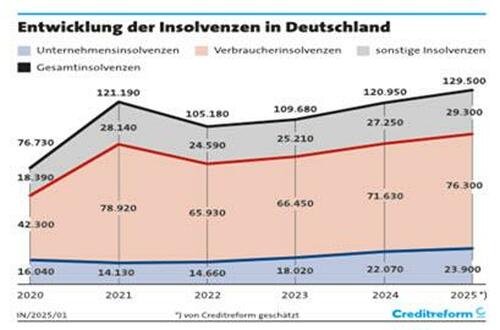
    The year 2025 is ending as a disastrous year for the German economy. Around 24,000 companies filed for insolvency—a record figure, surpassed only in the crisis year 2003 following the bursting of the dotcom bubble and the subsequent recession. Back then, a total of 39,000 companies went bankrupt.

    Deindustrialization and Loan Defaults 

    Loan defaults in the past year are estimated at around €57 billion. These losses hit suppliers and banks hard, especially since the German Mittelstand finances roughly 40% through savings banks and 25% through cooperative banks.

    Already in the previous year, losses from corporate insolvencies had accumulated to around €59 billion. The causes have long been known: the persistent weakness of the German economy results from a toxic mix of overregulation, climate-policy-driven deindustrialization, a self-inflicted energy crisis, and high fiscal burdens. This poisonous cocktail severely strains the economy, weakens private demand, and makes industrial production in Germany increasingly unattractive on the international stage.

    The ripple effects of a roughly 20% drop in industrial production reach far into other sectors. Supplier companies as well as industry-related services are increasingly under pressure—and are collapsing in many areas.

    Pressure Beneath the Surface 

    At first glance, the German banking sector still appears stable. Industry giant Deutsche Bank increased its pre-tax profit in Q3 2025 by 8% year-on-year to €2.4 billion. The bank saw growth across all business areas—from traditional lending to investment banking to asset management.

    The situation is different for cooperative banks. Volks- und Raiffeisenbanken already suffered a 25% drop in profits last year compared to the previous year. Further revenue declines are expected for 2025. The main reasons are the persistently weak economy, rising geopolitical tensions, and higher risk provisions in the face of growing credit default risks.

    Germany’s once stable three-pillar banking model—private large banks, public-sector institutions like savings banks and state banks, and cooperative banks—still shows outward growth. But beneath the surface, deep cracks are forming: years of low interest rates have sharply squeezed bank margins, and the abrupt interest rate reversal is weighing on both businesses and consumers. Added to this is the problematic close entanglement between cooperative banks and politics.

    For example, the agricultural cooperative BayWa in Bavaria nearly went bankrupt after engaging in global renewable energy investments—leaving a €100 million loss.

    This example illustrates the risks of political steering of the banking sector through public institute credit guarantees like KfW. Nowadays, billions are channeled annually into the climate economy and the military sector—keeping a zombie economy afloat that could never survive in a free capital market.

    Examples of the emerging banking crisis are multiplying: VR-Bank Dortmund Nordwest suffered losses of €280 million from risky real estate fund investments, requiring a bailout from the Cooperative Protection Fund (BVR).

    VR-Bank Bad Salzungen-Schmalkalden lost a similar amount in dubious real estate deals two years ago and also called on the BVR for rescue. These cases show that banks, facing a declining credit business with the Mittelstand, are forced to move outward on the risk curve to generate operational profits.

    The effects are tangible: a BaFin analysis shows that last year, about 1.9% of savings bank loans and 2.2% of cooperative bank loans were non-performing. This corresponds to a volume of €36.5 billion—a 25% increase from the previous year. Consequently, banks are forced to increase credit risk provisions—freezing more capital and making new loans harder to grant.

    Branch Closures and a Mortgage Crisis on the Horizon 

    Raiffeisenbank Hochtaunus recently fell into serious financial trouble after making €500 million in value adjustments to its real estate portfolio.

    Creaking sounds are coming from all corners of the German economy. It is expected that the economic crisis will translate into a crisis of regional banks’ mortgage portfolios, alongside private insolvencies. Stress in the banking system is increasing quarter by quarter.

    Banks are responding to growing pressure with tough measures. Over 1,000 bank branches are closed annually in Germany. The local Sparkasse may soon become a thing of the past. This not only makes personal consultations harder for older customers but also hits bank clients in rural areas. Small and medium-sized enterprises, craft businesses, bakeries, and local retailers who rely on personal financial advice increasingly find fewer direct contacts and a trusted banking environment.

    Balance Sheet Damage Becomes Visible 

    Bank balance sheets reflect the overall economic situation. At the same time, they are influenced by financial and fiscal policy developments. Years of elevated loan defaults erode the financial substance of banks just as much as the globally high sovereign debt, which has caused significant devaluations of bond holdings on balance sheets.

    In short: the longer the crisis in the private economy persists and the more it is exacerbated by fiscal undiscipline and growing government debt, the lower the lending potential of the banking sector.

    This is precisely the crux of monetary policy. The European Central Bank can lower interest rates and private sector financing costs all it wants. Lending in the real economy is determined by the interaction between private companies and credit-granting banks.

    Unless Germany’s economic outlook brightens considerably—which, under current political conditions, is unlikely—lending will significantly slow on the one hand, while defaults accelerate on the other. This would be further evidence that the German economy is continuing to sink deeper and deeper into a contraction phase.

    * * * 

    About the author: Thomas Kolbe is a German graduate economist. For over 25 years, he has worked as a journalist and media producer for clients from various industries and business associations. As a publicist, he focuses on economic processes and observes geopolitical events from the perspective of the capital markets. His publications follow a philosophy that focuses on the individual and their right to self-determination.
    Loading recommendations…
  • Germany’s Family Businesses Warn: Taxes, Energy Costs, And Bureaucracy Are Killing Competitiveness

    Germany’s Family Businesses Warn: Taxes, Energy Costs, And Bureaucracy Are Killing Competitiveness

    Submitted by Thomas Kolbe

    At the turn of the year, the Foundation for Family Businesses, together with the ifo Institute, presented a corporate survey on tax policy and location attractiveness. The result is unequivocal: Germany is too expensive and no longer competitive as a business location.

    There is nothing new under the sun. In their year-end Annual Monitor, the Foundation for Family Businesses and the ifo Institute once again went straight to the heart of the matter. A total of 1,705 companies across all sectors and size categories were surveyed on their assessment of current tax policy and Germany’s attractiveness as a business location. The evaluation of this corporate panel—1,358 of which were traditional family-owned businesses—turned out to be devastating, as expected.

    Overburdened Labor Factor

    More than 80 percent of companies perceive the overall tax and contribution burden—particularly in the area of personnel costs, i.e., wage taxes and social security contributions—as far too high. The heavy burden on the employee side is especially criticized by smaller family-owned businesses. It has become increasingly difficult to grant wage increases when the fiscal authorities take the lion’s share and key performers are bled ever more heavily with each pay raise due to the continuous increase in social security contribution ceilings.

    This assessment is shared by Professor Rainer Kirchdörfer, member of the Foundation’s executive board, who comments on the study:
    “Our new Annual Monitor shows just how much employers and employees are pulling in the same direction. It is precisely the high taxes on labor that paralyze both sides and drain the joy from performance. High-tax Germany has also lost ground here.”

    Two-thirds of surveyed executives complain about excessive income tax rates. Income tax is particularly relevant for partnerships—and by international standards it is clearly too high. A recurring grievance is also the complexity of Germany’s tax system. The familiar quip holds that roughly two-thirds of global tax law literature originates in the Federal Republic. Even if exaggerated, the message is clear: Germany is a bureaucrat’s paradise.

    Currently, 5.4 million people work in the public sector—around half a million more than five years ago. This despite technological progress, artificial intelligence, and increasing automation of internal processes.

    The Bureaucracy Reduction Classic

    A tangible reduction in bureaucracy, including tax law, has been overdue for decades. Yet no federal government dares to tackle this hot potato. German bureaucracy has grown too powerful, evolving at all levels into a state within the state. At the same time, policymakers view the public sector as a kind of buffer for a labor market that has slowly but steadily tipped.

    As a reminder: over the past three years, German companies have been forced to create 325,000 additional jobs merely to cope with the ever-expanding bureaucratic workload. The state is effectively outsourcing its ballooning documentation, archiving, and compliance requirements to the private sector.

    Ranked second and third among entrepreneurs’ main points of criticism are rising local business taxes (Gewerbesteuer) and energy-related levies. Both factors are likely to play a significant role in 2026. Municipal budgets, paralyzed by a cumulative deficit of €35 billion last year, are virtually screaming for sharp increases in local business tax rates.

    This threatens to trigger a tax-driven recessionary spiral initiated by local governments seeking short-term relief—particularly in regions hard hit by the industrial downturn, such as the automotive hubs of Stuttgart, Ingolstadt, and Wolfsburg.

    Additional Pressure from Energy Levies

    As of January 1, 2026, under the Fuel Emissions Trading Act (BEHG), the CO₂ price corridor will rise to between €55 and €65 per ton. This represents another substantial erosion of Germany’s economic substance, as it struggles to keep energy-intensive production in the country amid intensifying competition with China and the United States.

    Entrepreneurs’ demands are clear: a reduction in the electricity tax is long overdue as a first step toward restoring the competitiveness of German industry. The abolition of the solidarity surcharge, alongside an accelerated reduction in corporate taxes, also ranks high on the business community’s wish list for the coming year.

    Germany is too expensive as a business location by OECD standards. Since 2018, this has also become evident in overall economic productivity, which has stagnated and even declined slightly in recent quarters.

    Valid Criticism, But the Root Problem Remains Untouched

    There is no question that entrepreneurs are correct in their assessment of fiscal overburdening on companies and private households. The German state has expanded excessively and—given steadily rising public debt—is increasingly living at the expense of future generations.

    What is striking, however, is what the study fails to address. Neither the billion-euro follow-up costs of migration into Germany’s welfare system nor the fiscal and real-economic consequences of centrally planned climate policy are included in the assessment. Yet both factors significantly contribute to rising tax burdens and have sustainably weakened Germany’s industrial base.

    What has materialized in energy costs—burdens sometimes three times higher than those in competing locations such as France or the United States—must become the subject of a broad public debate if a return to rational economic policy is ever to be possible.

    Under the current federal government led by Chancellor Friedrich Merz, this appears fundamentally out of reach.

    If not Germany’s economic middle class, who should initiate such a debate openly and courageously? We are still waiting for the icebreaker capable of overcoming the dogma of the alleged lack of alternatives in climate policy in a practical, rational, and unresentful manner. And it remains all too easy for policymakers, operating in an entrenched mode of accelerated debt accumulation, to align incentive structures and a lavishly funded subsidy machine in such a way that any critical voice from the business sector is ultimately silenced.

    In the end, the study delivers a rapid situational assessment from which the familiar criticism emerges—criticism that, at all costs, seeks to avoid a collision with an ideologically hardened climate-socialist policy.

    Loading recommendations…